I'm Lauren Rath, a Mental Health Counselor licensed in Washington. I've spent seven years doing Internal Family Systems therapy, and Spokane is home. A lot of the people I work with almost didn't send that first email.
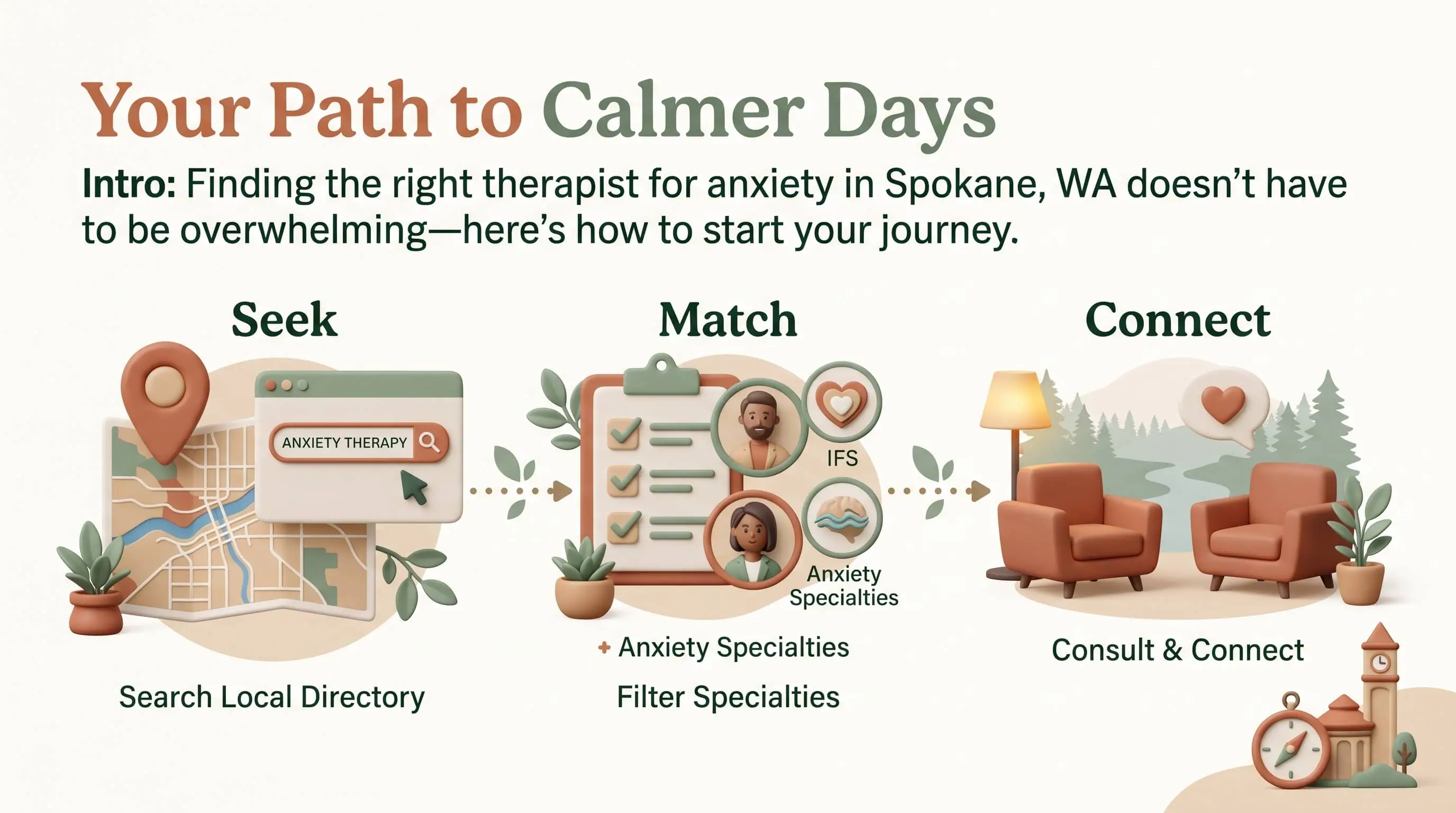
Finding a therapist for anxiety in Spokane, WA · IFS Therapy mostly comes down to knowing what to check, and none of it requires you to have the right words yet.
Healing has never been only physical, either. Chronic stress slows how the body heals, which may be part of why slow-healing wounds so often have a harder story underneath. Anxiety deserves the same patient attention a wound gets.
TL;DR Quick Answers
Therapist for Anxiety in Spokane, WA · IFS Therapy
Look for a Washington-licensed therapist who treats anxiety often and can explain their approach in plain words. IFS therapy is a strong fit when your anxiety seems to be protecting something older.
Check the license: confirm it's active on Washington's Provider Credential Search. An LMHC, LICSW, LMFT, psychologist or psychiatric ARNP can all treat anxiety.
Match the method: CBT suits panic and phobias. IFS suits worry that it feels like a guard on duty.
How IFS sees anxiety: as a protective part of you. You get to know it instead of fighting it, and it often eases once it feels heard.
Go online if you need to: a Washington-licensed therapist can see you by video anywhere in the state.
Start small: a free 15-minute consult tells you more than any profile.
Top Takeaways
Check the license first. Washington's Provider Credential Search shows status and any discipline in about a minute.
Match the method to your anxiety. CBT for panic and phobias, ACT for worry loops, EMDR for frightening memories, and IFS when the anxiety seems to be guarding something.
IFS treats anxiety as a protector. Nothing in you has to be removed, and the anxious part finally gets heard.
Telehealth opens up the whole state. A Washington-licensed therapist can see you by video as long as you're in Washington.
Use the free consultation. Fifteen minutes on the phone tells you more than any profile will.
What a Good Therapist for Anxiety in Spokane, WA Actually Helps You Do
A good anxiety therapist helps you understand your worry well enough that it stops running your day. Making it vanish was never the goal.
Anxiety is usually doing a job. It scans the room and rehearses the hard conversation three times before it happens. Somewhere along the way it learned that staying alert kept you safe, and nobody has told it otherwise.
Good therapy gets curious about that job before trying to change anything. A Spokane-based therapist who offers online anxiety therapy can help you explore that process. You'll know you're in the right room when you leave a session feeling a little more like yourself instead of more managed.
Check the License Before You Check the Bio
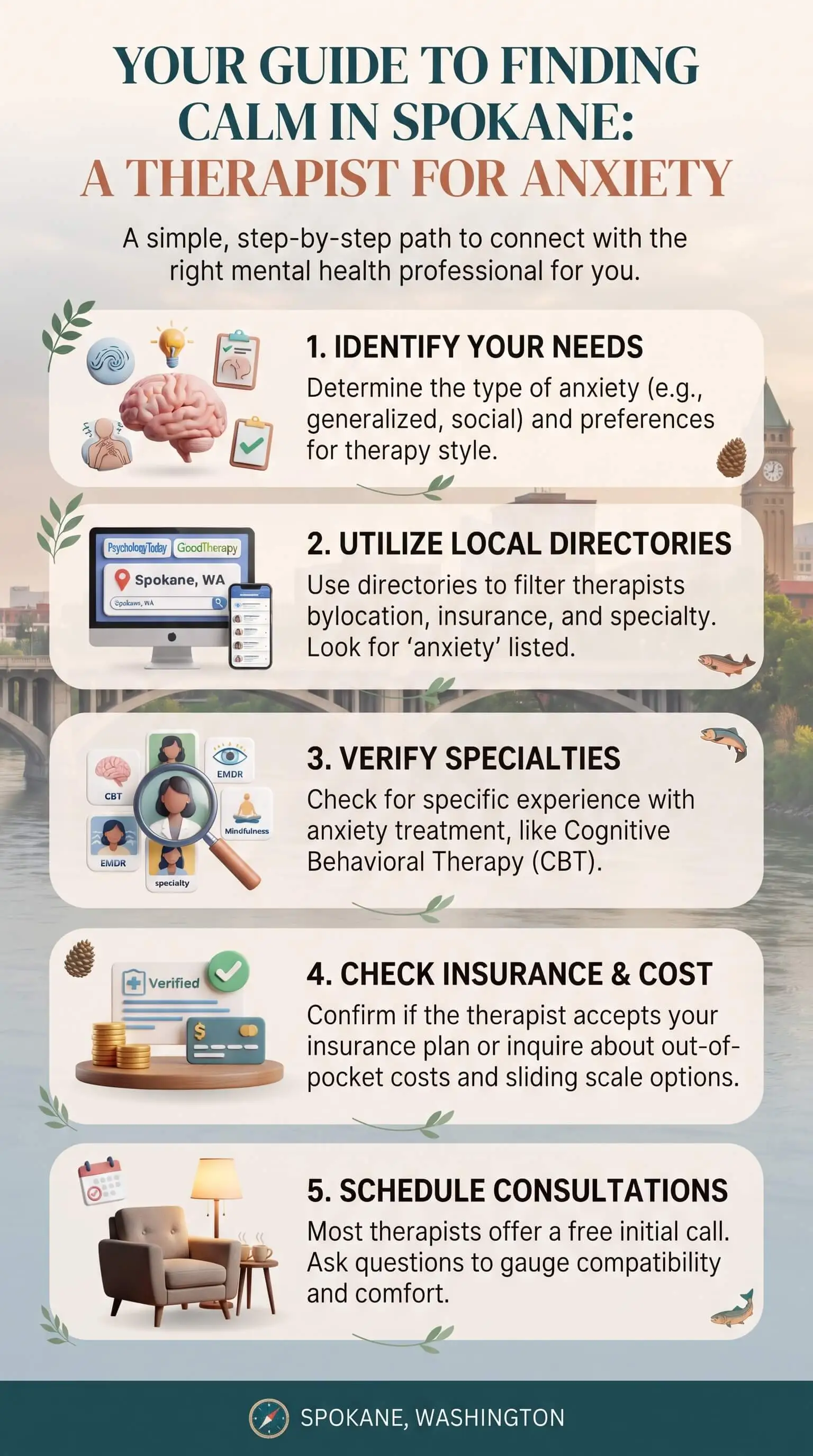
The license is the one thing on a therapist's profile you can verify, and it takes about a minute. In Washington, the people who treat anxiety usually hold one of these:
LMHC, Licensed Mental Health Counselor
LICSW, Licensed Independent Clinical Social Worker
LMFT, Licensed Marriage and Family Therapist
Licensed psychologist, with a PhD or PsyD
Psychiatric ARNP, a nurse practitioner who can also prescribe medication
You'll also see associate licenses like LMHCA and LMFTA. Those clinicians practice under a licensed supervisor, which is perfectly fine, and their waitlists are often shorter.
Type any name into the Washington State Department of Health's Provider Credential Search and you'll see whether the license is active and whether the state has ever disciplined that person. Do it for me, too.
Match the Approach to How Your Anxiety Works
Most good therapists draw on more than one method, but each method has a center of gravity, and the right fit depends on how your anxiety shows up.
CBT and exposure therapy suit panic attacks, phobias, and specific fears. Sessions are structured and skills-based, usually with practice in between. CBT has the longest research record for anxiety of any approach, and if panic is your main struggle, I'd look there first.
ACT, or Acceptance and Commitment Therapy, helps with worry loops you can't argue your way out of. It spends less effort changing thoughts and more on making room for them.
EMDR fits when anxiety traces back to specific frightening experiences, because it works directly with how those memories are stored.
IFS, or Internal Family Systems, fits when the anxious voice seems to be guarding something, or when you've already learned the coping skills and still feel stuck.
A therapist who can't explain in plain words which approach they'd use with you, and why, has told you something worth knowing.
Where IFS Therapy Fits for Anxiety
IFS treats anxiety as a protective part of you rather than a malfunction. Richard Schwartz developed Internal Family Systems in the 1980s, and it starts from something you already say. Part of me wants to go. Part of me wants to stay home.
In IFS, the anxious part is usually a protector that took the job on for a reason, often when you were young. Rather than argue with it, we get to know it, and once it feels heard, it tends to loosen its grip on its own.
I'll be honest about the research, because you deserve to know what's behind a method. The published IFS studies are still small. In a 2022 pilot study, 17 adults with PTSD and histories of childhood trauma completed 16 IFS sessions and showed significant improvement. That's encouraging, and it's also a long way from the decades of trials behind CBT.
Still, I've watched IFS reach places that coping skills alone didn't, especially when anxiety sits on top of older pain. I've written about what IFS therapy looks like week to week for adults across Washington, including how the online sessions work.
In Person in Spokane or Online Anywhere in Washington
Both work well, so pick whichever makes it easiest to keep showing up.
An office gives you a separate room and a drive home to let things settle. Telehealth skips the drive and the waiting room, along with the icy parking lot on a January morning. Plenty of anxious people find it easier to open up from their own couch, with their own dog asleep on their feet.
One rule matters here. A Washington-licensed therapist can see you by video only while you're physically in Washington, so your search covers the whole state, well past Spokane and Spokane Valley.
For privacy, a door that closes and a pair of headphones will do. A parked car works too, and more people use one than you'd guess.
Questions to Ask in a Free Consultation
Most therapists offer a free 15-minute call, and it will tell you more than any profile. Bring these questions:
How often do you work with anxiety like mine, whether that's panic, constant worry, or social anxiety?
What approach would you use with me, and why?
What does a typical session actually look like?
What do you do when something starts to feel like too much?
What happens if we're not a good fit?
Then pay attention to how you feel on the call. Relief counts, and so does a quiet sense of being rushed.
Cost, Insurance, and Waitlists in Spokane
Get the cost in writing before you start. Call your insurer, ask the therapist directly, and see whether the two answers match.
I'm in-network with BCBS, Aetna, Regence, Premera, and Cigna, and many Spokane therapists take at least one of those. If you pay out of pocket, the No Surprises Act entitles you to a written Good Faith Estimate before your first session.
If the therapist you want has a waitlist, ask who they'd refer you to or widen your search through telehealth. A waitlist is a detour, and you can usually find a way around it.
"Most people who come to me for anxiety have spent years trying to get the worried part to be quiet. So I ask for something else. What are you afraid would happen if you stopped? The answer almost never has anything to do with today. It belongs to someone much younger, who once needed that vigilance to get through. Once the anxious part realizes it doesn't have to stand guard alone anymore, it usually relaxes faster than anyone expected, including the person it belongs to."
7 Essential Resources
Where I'd send a friend in Spokane who was still deciding.
Washington State Provider Credential Search: the state's own lookup for any therapist's license type, status, and disciplinary record, updated daily.
NIMH: Anxiety Disorders: plain federal explanations of generalized anxiety, panic disorder, social anxiety, and phobias, plus free brochures you can read before a first session.
NIMH: Help for Mental Illnesses: next steps for finding care for yourself or someone you love, with no sales pitch attached.
Telehealth for Behavioral Health Care: what online therapy can include and how to get set up, from the federal telehealth office.
Frontier Behavioral Health: Spokane's nonprofit community mental health provider. It accepts Medicaid, offers outpatient therapy, and answers a 24/7 regional crisis line at 1-877-266-1818.
Washington 211: dial 211 or search online for sliding-scale counseling and local support programs.
What to Expect From the 988 Lifeline: who answers when you call, text, or chat 988, and what they'll ask. Reaching out is easier when you know what happens next.
3 Statistics
Three numbers I come back to when someone tells me they're probably overreacting.
Anxiety Is the Most Common Thing People Carry In
An estimated 19.1% of U.S. adults had an anxiety disorder in the past year, and 31.1% will have one at some point in their lives.
That's close to one in five this year.
Stand in a ten-person coffee line on Monroe Street, and the odds say two of the people around you are carrying it right now.
Source: NIMH: Any Anxiety Disorder
Most People Who Could Use Help Aren't Getting It
Generalized anxiety disorder affects 6.8 million American adults, and only 43.2% are receiving treatment.
Fewer than half.
Cost, waitlists, distance, and the nerve it takes to send that first email all live in the gap.
Telehealth closes part of it, and a free consult closes a little more.
Source: ADAA: Anxiety Facts and Statistics
Chronic Stress Slows Healing
In a 1995 study published in The Lancet, family caregivers of people with dementia took about nine days, or 24%, longer to heal a small standardized wound than matched controls.
Your mind and body don't keep separate books.
Anyone recovering from a wound or a surgery has good reason to take their anxiety seriously too.
Source: Stress and Wound Healing Research Review (PubMed Central)
Anxiety affects millions of Americans, yet fewer than half of those with generalized anxiety disorder receive treatment. Research also shows that chronic stress can delay physical healing, highlighting how managing anxiety and maintaining prоpеr wоund cаrе both contribute to overall well-being.
Final Thoughts and Opinion
Here's an opinion I'll stand behind. The right therapist for your anxiety is the one your anxious part relaxes around, and that counts for more than the length of anyone's list of methods.
You can check a license in a minute and read up on CBT and IFS in an afternoon. What you can't fake is the moment, usually around the second or third session, when the vigilant part of you sets down a little of what it's been carrying. That's the signal worth trusting.
After seven years of this work, a few things have stopped surprising me:
Almost everyone apologizes the first time they cry in session. There's nothing to apologize for.
The part that worries most is usually the one working hardest to protect you.
Change tends to show up in other people's comments first. A partner mentions you didn't spiral over that email, and you realize they're right.
The people most afraid of picking the wrong therapist tend to do the most careful, honest work once they start.
Your anxiety adapted to keep you safe, and it did that job well. Therapy gives it a chance to rest.
Frequently Asked Questions
Q: How Do I Know If I Need a Therapist for Anxiety?
A: If worry is costing you sleep, focus, relationships, or plain ease, that's reason enough. You don't need a diagnosis or a crisis first. Most people wait longer than they need to.
Q: What Kind of Therapist Is Best for Anxiety in Spokane, WA?
A: Look for a Washington-licensed clinician who works with anxiety regularly and can explain their approach in plain words. That could be an LMHC, LICSW, LMFT, psychologist, or psychiatric ARNP. How you feel with the person matters as much as the method.
Q: Is IFS Therapy Good for Anxiety?
A: For many people, yes, especially when anxiety sits on top of older pain. The research so far is small and encouraging, and CBT still has the longer track record. A good IFS therapist will tell you that up front.
Q: Can I See a Spokane Therapist Online From Elsewhere in Washington?
A: Yes. A Washington-licensed therapist can see you by video anywhere in the state. You just need to be physically in Washington during each session.
Q: How Much Does Anxiety Therapy Cost in Spokane?
A: It depends on your plan and the clinician. In-network sessions usually mean a copay or coinsurance. Paying out of pocket, you're entitled to a written Good Faith Estimate before you begin.
Q: Does Insurance Cover Therapy for Anxiety in Washington?
A: Call the number on your card and ask which therapists near you are in-network and what you'll actually pay per session once any deductible is met. Frontier Behavioral Health accepts Medicaid in Spokane County.
Q: What Should I Ask During a Free Consultation?
A: Ask how often they treat anxiety like yours, which approach they'd use, what sessions look like, how they handle overwhelm, and what happens if it's not a fit. Then notice how you feel on the call.
Q: What If I Need Help Right Now?
A: Call or text 988 any time, or call Frontier Behavioral Health's 24/7 regional crisis line at 1-877-266-1818. If you're in immediate danger, call 911.
Take the First Step
Reaching out takes more than it looks like from the outside, and some part of you may already be talking you out of it. That part is welcome here too.
If you're in Washington and IFS sounds like a fit, one sentence is enough to start. Book a free 15-minute call, and we'll see how it feels. Free, 15 minutes, no pressure.


