Walk into any clinic and you’ll see a wall of credentials. Board certifications, years of training, thousands of patients treated. Now pull up the same clinic’s website. The copy reads like a brochure pulled from a template. Condition pages explain symptoms the way a textbook would, not the way a worried patient describes them on Google at 2 a.m. And the practice that should be the obvious choice in its market stays invisible behind three competitors with better-written pages.
That gap, between what a clinic knows and how its website actually communicates it, is what specialized medical healthcare copywriting services exist to close. Better copy ranks higher in search. It earns patient trust faster. It turns more site visits into booked appointments. It isn’t decoration. It’s one of the most overlooked growth levers in healthcare right now.
TL;DR Quick Answers
medical healthcare copywriting services
Medical healthcare copywriting services produce the written content medical practices, clinics, and health businesses use to attract patients and earn trust online. The work spans web pages, SEO blog posts, email campaigns, paid ads, and printed direct mail.
What separates these services from general copywriting:
Writers operate inside Google's YMYL standard, which grades health content against a stricter quality bar than commercial content faces
Every page has to clear two checks at once: clinical accuracy and patient-friendly readability
HIPAA, FTC, and FDA constraints shape what a clinic can and cannot claim about treatments or outcomes
E-E-A-T signals (verifiable author credentials, cited sources, first-hand experience) carry disproportionate weight in healthcare search rankings
The practical result: clinics that hire specialists rank higher, convert more visitors, and book more appointments than competitors using generic agency copy.
Top Takeaways
Google grades healthcare content against its YMYL standard, which is much stricter than the bar applied to ordinary commercial copy.
Generalist copywriters consistently miss the clinical accuracy, regulatory awareness, and patient empathy healthcare actually requires.
Specialized copywriters move measurable numbers: higher organic traffic, better conversion rates, and more booked appointments.
E-E-A-T signals (author credentials, cited sources, first-hand experience) carry disproportionate weight in healthcare rankings.
The best healthcare copywriting investments compound over six to twelve months as content ranks, builds trust, and converts at scale.
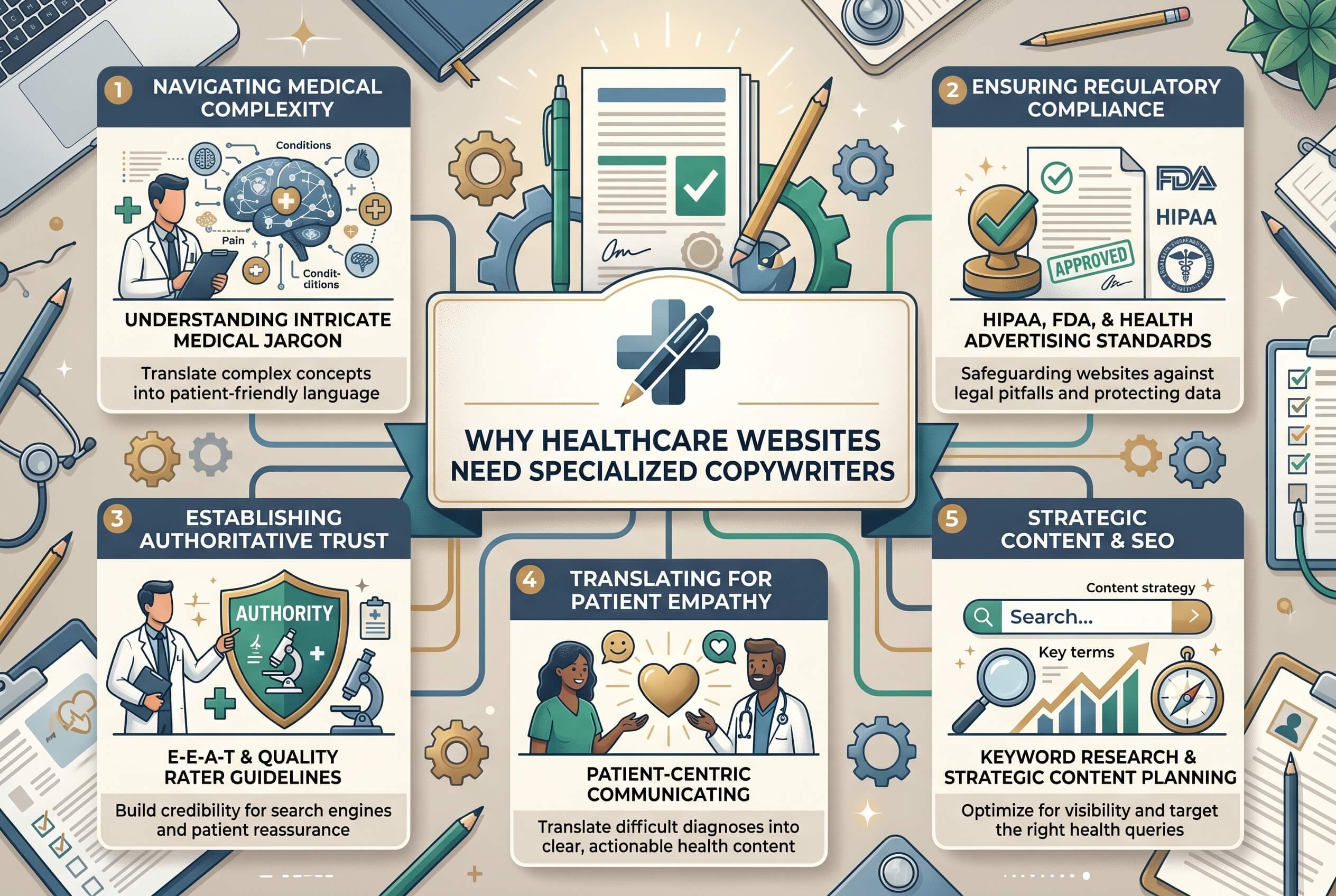
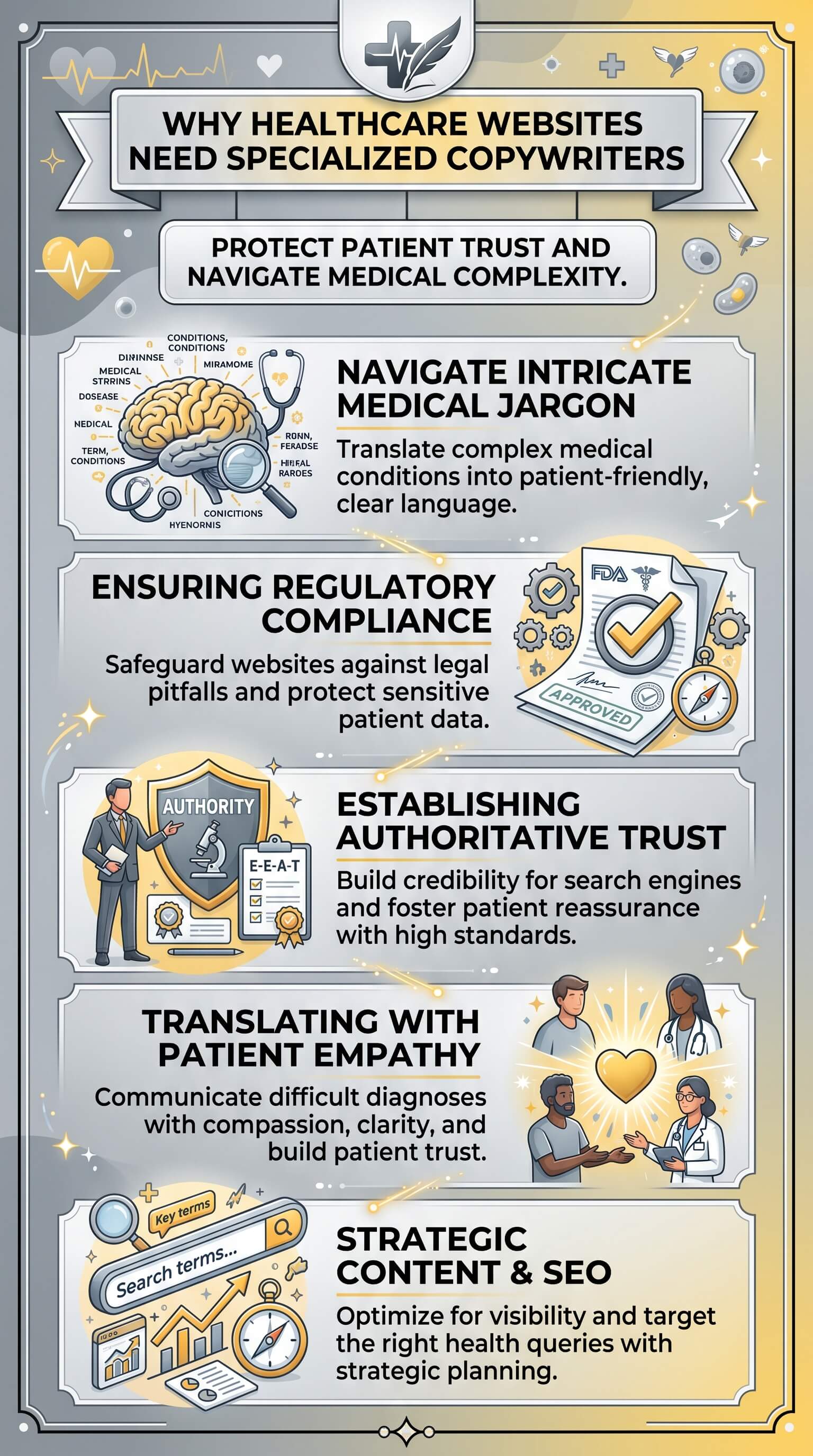
What Makes Healthcare Copywriting Different
Google sorts content into categories. The one healthcare is called YMYL, short for Your Money or Your Life. Anything that affects health decisions, money decisions, or personal safety gets graded against a much stricter standard than commercial content faces. Google’s quality raters check for clinical accuracy, named authors with verifiable credentials, cited sources, and a publishing history that holds up to scrutiny. Pages that come up short on those checks rarely crack the top results.
That stricter standard reshapes how the writing has to work. Standard copywriting fundamentals still apply: persuasion, structure, headlines, the call to action that closes the page. But healthcare copy stacks more on top. The writer needs medical literacy. The writer needs regulatory awareness, including HIPAA, FTC rules, and FDA guidance on health claims. The writer also needs patient empathy, the kind that translates clinical information into something a worried person can actually use. A copywriter whose only background is e-commerce or SaaS doesn’t have that stack, and it shows the moment a reader compares a clinic site to one written by a specialist.
Why Generalist Copy Fails Clinics
The failure mode is the same almost every time. Generalist copy gets the surface right and the substance wrong. Pages look polished but read like brochures. Conditions get described too clinically for patients to follow, or so simplified that the practice’s own physicians wince. HIPAA language is either missing or pasted in from a template last updated three administrations ago. Keyword targeting hits phrases patients never search for in the first place.
There’s a quieter failure mode worth naming. AI Overviews and search engines have gotten much better at sniffing out content that lacks genuine Experience and Expertise. Pages with no author byline, no source citations, and no first-hand insight quietly slide down the rankings, and nobody on the clinic’s team notices until traffic dries up. We’ve watched plenty of clinics get outranked by competitors who simply invested in a specialist while they were trying to save money on a generalist.
What a Specialized Healthcare Copywriter Actually Does
The work goes deeper than writing words. It starts with conversations. The copywriter sits down with the practice owner or lead clinician and gets them to articulate what actually makes the practice different from the three other clinics on the same block. Then research takes over. Condition pages have to match the way patients describe their symptoms, not the way textbook chapters describe them. Service pages have to anticipate the questions patients are too embarrassed to ask out loud. Blog content has to answer the queries patients type at 2 a.m. when they can’t sleep.
Deliverables typically include brand messaging, web pages, SEO blog content, email sequences, paid ads, and sometimes printed direct mail. Strong specialists also write with the implementation team in mind. That means leaving formatting notes, schema suggestions, and intent comments in the draft itself, so designers, developers, and marketing managers can build from it without guessing. Providers like Riley James Copy have built entire businesses around this kind of work, offering medical healthcare copywriting services to private practices, group practices, and the marketing agencies that serve them.
How Specialized Copy Drives Patient Acquisition
Better copy moves measurable numbers. Pages written around patient intent rank higher because they answer the questions Google’s algorithm cares about. Higher rankings bring more organic traffic. Clearer, more direct content holds reader attention longer, which lowers bounce rates and pushes rankings further up. The loop compounds. Six months in, you’re getting traffic you weren’t getting before. Twelve months in, you’re booking patients from search who would never have heard of you otherwise.
The case studies back this up. One occupational health clinic rebuilt its site around a specialist’s framework and ended up ranking #1 for 33 different patient-acquisition keywords. Call volume climbed dramatically inside a few months. That outcome isn’t an outlier. It’s what well-researched, patient-focused content does when a clinic owner commits to it.
“When we first met, I told Riley that I wanted to ‘dominate the market,’ and we are doing just that. After listening carefully to my hopes for the clinic, he quickly developed great looking pages and worked behind the scenes to build a high SEO ranking site. Since then, our call volume has risen dramatically and awareness of our clinic has grown in our area and beyond, landing us several new contracts as we make our mark in the area.”
7 Essential Resources
If you’re evaluating copywriting partners or auditing the content you already have, these references are worth bookmarking. Each one is either an authoritative guideline, a regulatory source, or a working example of specialized healthcare copywriting in practice.
Google Search Quality Rater Guidelines: Google’s own document defining E-E-A-T and YMYL standards that human raters use to grade page quality.
HHS HIPAA Marketing Guidance: the federal line on what counts as marketing under HIPAA and which patient communications require authorization.
Federal Plain Language Guidelines: the gold standard for writing health information at a level patients can actually read and act on.
AMA Manual of Style: the citation and writing style guide JAMA Network and most peer-reviewed medical publications follow.
CDC Plain Language Materials and Resources: practical tools, including the Everyday Words for Public Health Communication list.
Wikipedia: Copywriting: background on the discipline, its branches, and how specialization developed over time.
Riley James Copy Healthcare Copywriter Services: a working example of medical healthcare copywriting services, with documented case studies in clinic growth.
3 Statistics
Three numbers explain the case for specialized healthcare copy. Patients start their research online. Conversion rates vary wildly based on content quality. And digital expectations keep climbing every year.
77% of online health seekers start their research at a search engine like Google or Bing rather than a dedicated health portal. Source: Pew Research Center, Health Online 2013. If your practice doesn’t show up in those results, the patient never finds you.
The median patient conversion rate sits at 3.6%, while the top 25% of healthcare landing pages convert at 20.4%. Source: Runner Agency analysis of Unbounce industry data. That’s a five-times gap between average and excellent, measured in booked appointments per visitor.
75% of consumers say they want digital healthcare services that actually meet their needs. Source: McKinsey research via Healthcare Dive. Practices without strong digital content hand those patients to competitors who deliver.
Final Thoughts and Opinion
The clinics that win the next ten years of patient acquisition won’t be the ones with the prettiest websites. They’ll be the ones whose content actually educates, reassures, and converts. That’s not work for a generalist who took a copywriting course on YouTube last spring. It’s work for someone who’s spent years inside healthcare marketing, knows what HIPAA allows, understands how patients describe their own symptoms, and has the patience to earn trust paragraph by paragraph.
Our position, after auditing dozens of clinic sites: practices treating healthcare copywriting as a serious investment rather than a line item to outsource as cheaply as possible are the ones quietly pulling ahead in search rankings and call volume. Every clinic competing on visibility is, in practical terms, competing on the quality of its words. The sooner that lands, the sooner the phone starts ringing.
Frequently Asked Questions
What is a healthcare copywriter?
A healthcare copywriter writes marketing and educational content specifically for medical practices, clinics, and health businesses. They combine persuasive writing skills with medical literacy and patient-first communication.
How is medical copywriting different from regular copywriting?
Medical copywriting demands clinical accuracy, patient empathy, and awareness of healthcare regulations like HIPAA. It also has to clear Google’s YMYL quality bar, which most other copywriting categories never face.
Do healthcare copywriters need a medical degree?
No. The skills that matter most are research discipline, persuasive writing, and the ability to translate clinical expertise into patient-friendly language. The strongest healthcare copywriters work closely with clinicians without holding a clinical license themselves.
How much does specialized healthcare copywriting cost?
Rates vary, but specialized work generally commands a premium over generalist copy. A full website project ranges from a few thousand dollars to tens of thousands depending on scope. Ongoing blog work usually bills per piece or on a monthly retainer.
How long does a healthcare website project take?
A four-page website usually takes a specialist about a week of actual writing, plus discovery, research, and review on either side. Most full projects wrap inside four to six weeks.
Can a healthcare copywriter help with SEO?
Yes. Strong healthcare copywriters bake SEO into the writing itself: keyword research, heading structure, internal linking, metadata, and schema recommendations.
What is YMYL content and why does it matter for medical websites?
YMYL stands for Your Money or Your Life. Google applies stricter quality standards to pages that affect health, finances, or safety. That’s exactly what makes specialized healthcare content essential for ranking well.
How do I know if my clinic needs specialized copywriting?
If your traffic is flat, your bounce rate is high, or your competitors are outranking you on the same keywords, your copy is almost certainly the bottleneck. A content audit by a healthcare specialist will usually reveal the gap in under an hour.
Call to Action
If your clinic isn’t booking the patient volume your team is built to handle, the words on your website are almost certainly the reason. Talking with a healthcare copywriting specialist is the fastest way to find out what’s working, what isn’t, and what a content overhaul could realistically deliver. Talk to a healthcare copywriter and start building a site that earns trust and books appointments.